
What is Mining Difficulty? (and Why It Changes Every 2 Weeks)
Read Time: 4 minutes
If hashrate is the engine of Bitcoin mining, then difficulty is the throttle.
It quietly adjusts in the background, ensuring that no matter how many miners join the network, Bitcoin continues producing blocks roughly every 10 minutes.
Understanding mining difficulty is critical for anyone serious about mining. It affects your profitability, your expectations, and your long-term strategy.
What is Mining Difficulty?
Mining difficulty is a measure of how hard it is to find a valid Bitcoin block.
The higher the difficulty, the more computational work is required to solve the cryptographic puzzle that produces a block.
In simple terms:
- Low difficulty = easier to find blocks
- High difficulty = harder to find blocks
But here’s the key: difficulty is not fixed.
It automatically adjusts based on how much total hashrate is on the network.
Why Does Difficulty Change?
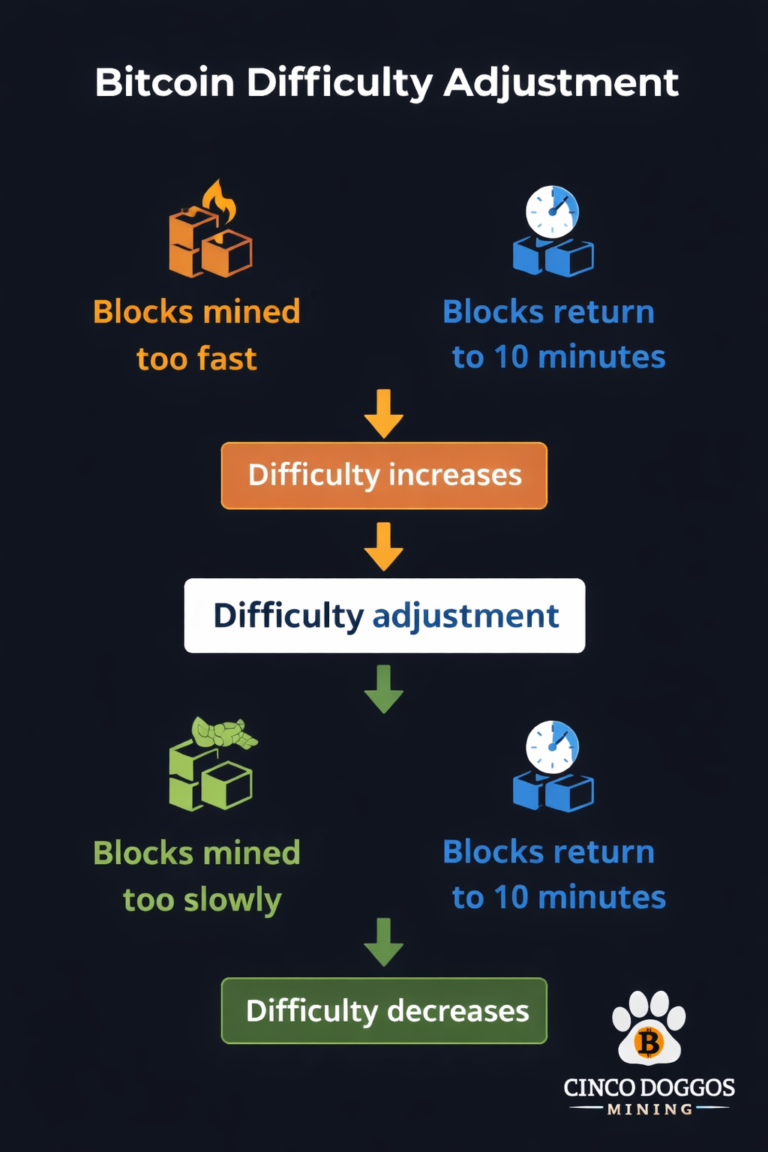
Bitcoin was designed to produce one block approximately every 10 minutes.
But miners are constantly joining and leaving the network. Without adjustment, blocks could come too fast or too slow.
To fix this, Bitcoin includes a built-in correction mechanism.
Every 2,016 blocks (roughly every two weeks, give or take a few hours), the network recalculates difficulty.
- If blocks were found too quickly → difficulty increases
- If blocks were found too slowly → difficulty decreases
This keeps Bitcoin running like a metronome—steady and predictable.
How Difficulty Impacts Miners
Difficulty directly affects how much Bitcoin you earn.
When difficulty increases:
- You earn less Bitcoin for the same hashrate
- Competition between miners increases
When difficulty decreases:
- You earn more Bitcoin for the same hashrate
- Opportunities open up—especially for smaller miners
This is why experienced miners pay close attention to difficulty adjustments.
The Hidden Cycle: Expansion and Contraction
Difficulty doesn’t just move randomly—it follows cycles.
During bull markets:
- More miners come online
- Hashrate increases
- Difficulty rises
During tough conditions (high energy costs, lower prices):
- Some miners shut down
- Hashrate drops
- Difficulty can decrease
This creates windows of opportunity.
For home miners and smaller operations, difficulty drops can be some of the most profitable moments to mine.
Why This Matters for Your Strategy
If you’re mining long-term, difficulty teaches an important lesson:
Mining is not about short-term wins—it’s about staying in the game.
Difficulty increases over time as more infrastructure is built around Bitcoin.
But temporary drops reward those who stay online when others shut off.
In many ways, mining is a game of endurance.
Final Thoughts
Mining difficulty is Bitcoin’s way of maintaining balance.
No central authority controls it. No one can manipulate it. It simply responds to the total effort of the network.
For miners, understanding difficulty isn’t optional—it’s essential.
Because in Bitcoin mining, you’re not just competing against machines.
You’re competing against time, energy, and everyone else chasing the same block.
Part of the Bitcoin Mining Fundamentals Series
Continue Learning: