
What Is Bitcoin Mining?
Category: Fundamentals
Estimated reading time: 6 minutes
If you’ve spent any time around Bitcoin, you’ve probably heard the term Bitcoin mining.
Maybe you picture warehouses filled with computers. Maybe you’ve heard miners “solve complicated math problems.” Maybe you know mining uses electricity, produces Bitcoin, and somehow keeps the network running.
All of those descriptions contain a piece of the story, but none really explain what Bitcoin mining is.
At its core, Bitcoin mining is the process that secures the Bitcoin network, confirms transactions, and adds new blocks of transactions to Bitcoin’s blockchain.
And it does all of this without a bank, government, payment processor, or other central authority deciding which transactions are valid.
Bitcoin Needs a Way to Agree
Imagine a traditional bank.
When you send someone money, the bank keeps the official ledger. It checks that you have the money, processes the transaction, updates account balances, and prevents you from spending the same money twice.
Bitcoin has no central bank keeping its ledger.
Instead, thousands of computers around the world independently run Bitcoin software and maintain copies of the blockchain. The challenge is getting a decentralized network to agree on the order of transactions without putting one person or company in charge.
Mining is a critical part of how Bitcoin accomplishes that.
So, What Does a Bitcoin Miner Actually Do?
Bitcoin miners operate specialized computers called ASICs, short for Application-Specific Integrated Circuits.
Unlike your laptop or gaming PC, a Bitcoin mining ASIC is built for essentially one job: repeatedly performing Bitcoin’s SHA-256 hashing operation as quickly and efficiently as possible.
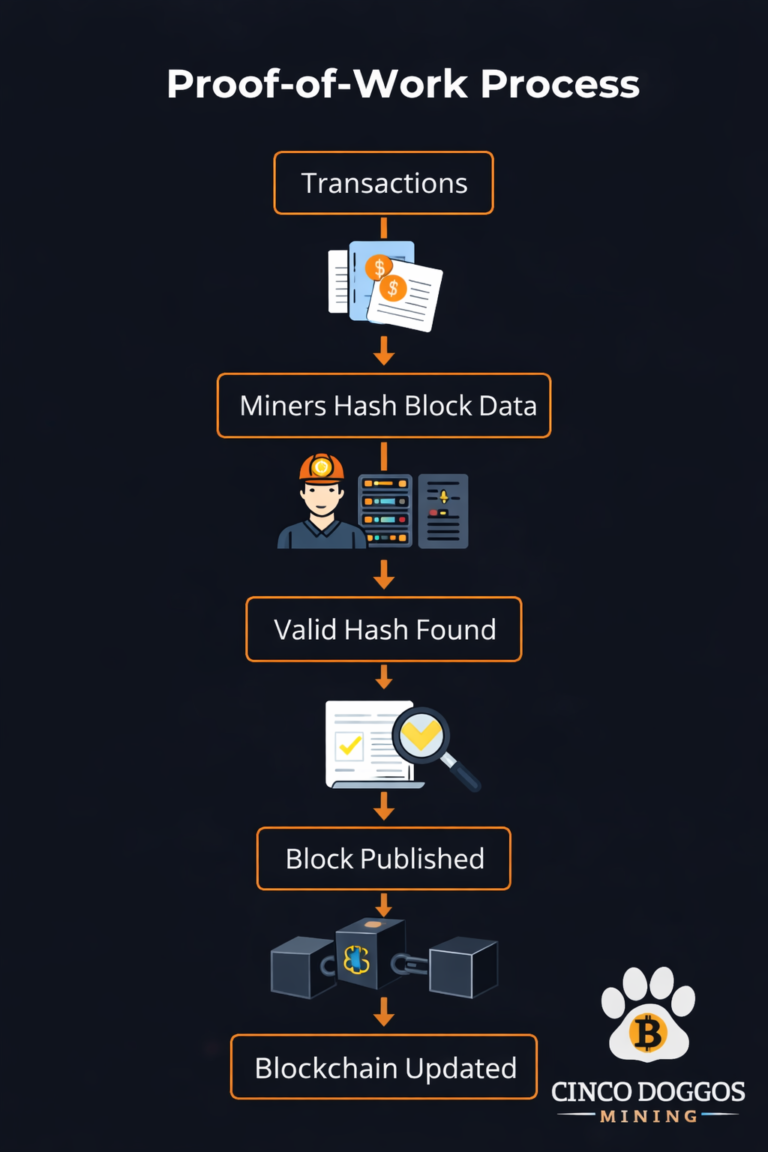
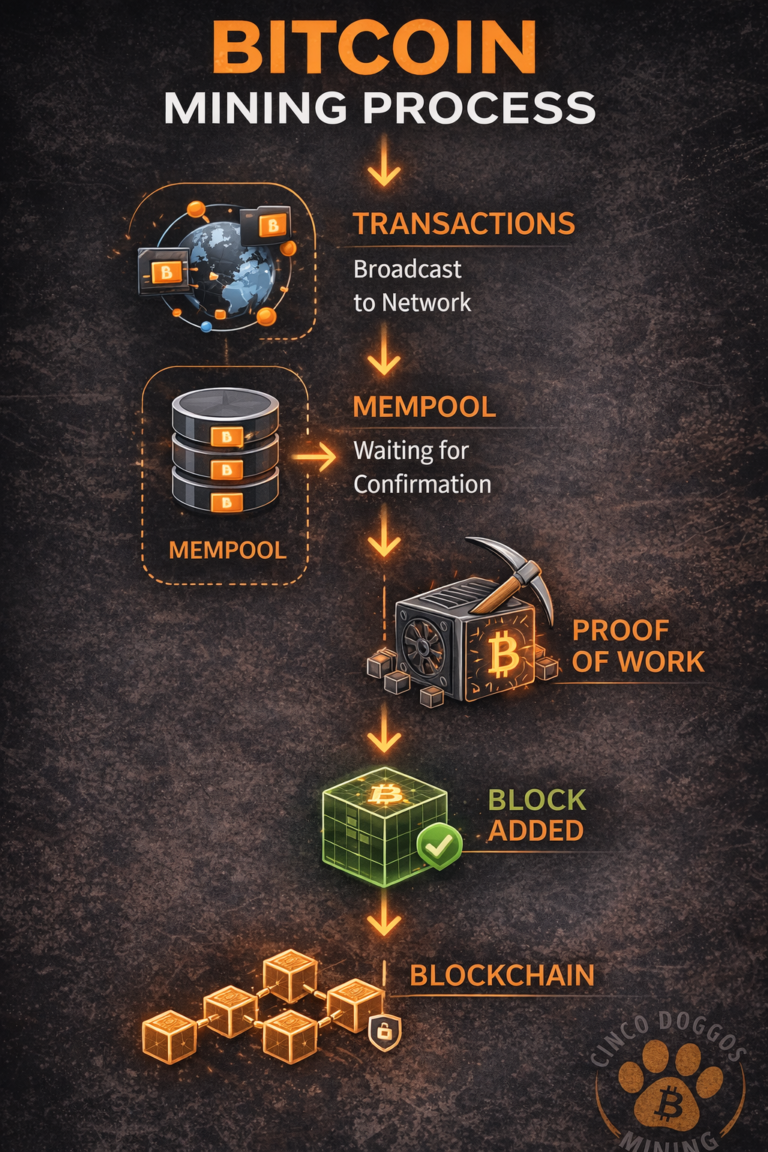
Miners gather candidate transactions into a proposed block and compete for the right to add that block to the blockchain.
They do this by repeatedly changing data in the block and hashing it, producing enormous numbers of potential results every second.
The goal is to produce a hash that meets the Bitcoin network’s current difficulty target.
There isn’t a shortcut.
A miner can’t reason its way to the answer or calculate the winning hash in advance. It has to keep trying.
Again.
And again.
And again.
Modern mining machines can perform hundreds of trillions of these attempts every second.
This computational competition is called Proof of Work.
Think of It Like a Giant Global Lottery
One simple way to visualize mining is as a lottery.
Every hash a miner performs is effectively another ticket.
A miner operating 500 terahashes per second is making roughly 500 trillion attempts every second.
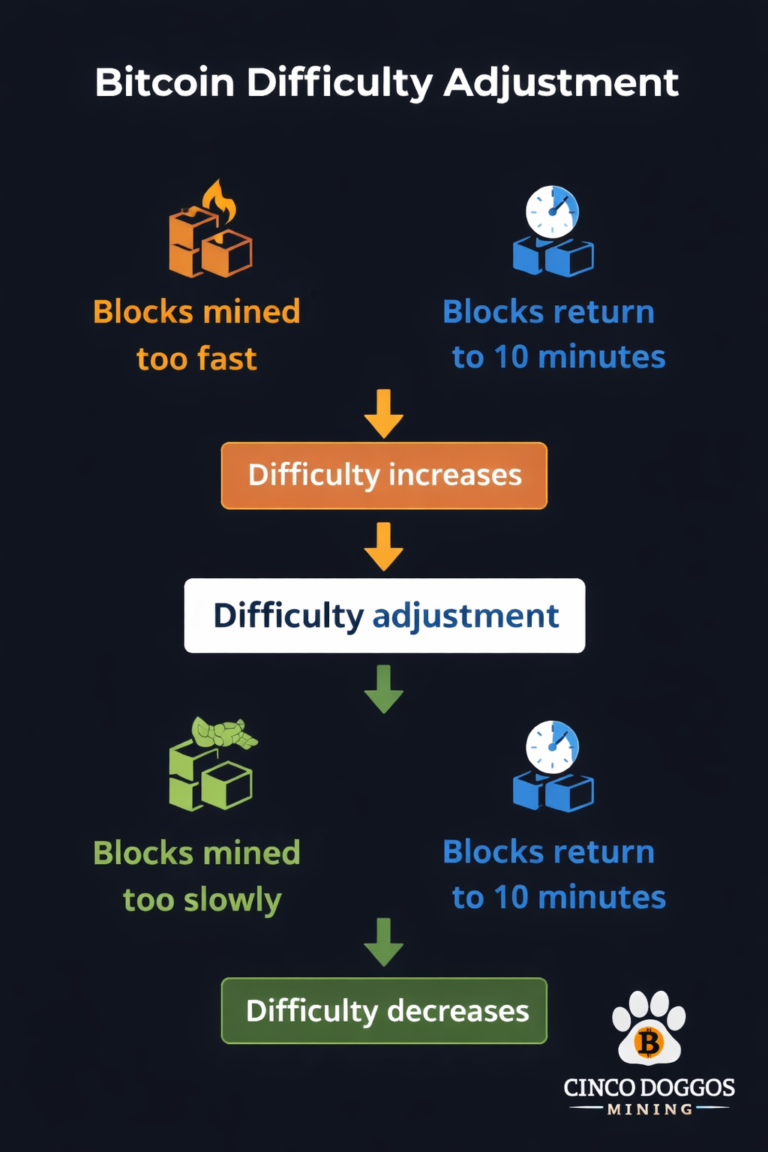
But unlike a normal lottery, Bitcoin automatically adjusts how difficult it is to find a winning result.
More miners join the network? The competition eventually gets harder.
Mining power leaves? It eventually gets easier.
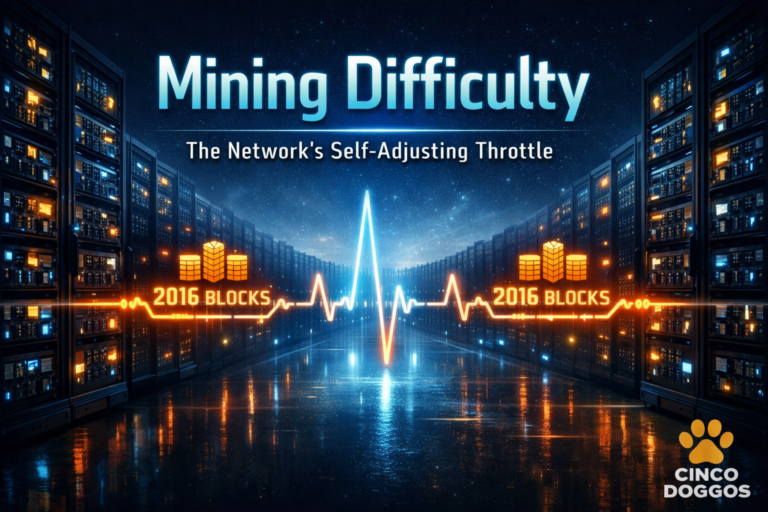
Bitcoin adjusts its mining difficulty every 2,016 blocks, roughly every two weeks, with the goal of keeping the average time between blocks near 10 minutes.
That rhythm continues regardless of whether Bitcoin is being mined by a handful of machines or enormous industrial facilities spread around the planet.
What Happens When a Miner Wins?
When a miner discovers a valid block, it broadcasts that block to the Bitcoin network.
Other Bitcoin nodes independently check it.
They don’t simply trust the miner.
They verify that the block follows Bitcoin’s rules: the transactions must be valid, coins can’t be created out of thin air, signatures must work, and the miner’s Proof of Work must satisfy the required difficulty.
If the block is valid, nodes accept it and the blockchain moves forward by another block.
The successful miner receives a block reward, consisting of two components:
- The block subsidy is newly issued bitcoin created according to Bitcoin’s predetermined monetary schedule.
- Transaction fees are fees attached to the transactions included in that block.
As of Bitcoin’s 2024 halving, the block subsidy is 3.125 BTC per block. That subsidy is cut approximately in half every four years until Bitcoin eventually approaches its maximum supply of 21 million bitcoin.
Over time, transaction fees are expected to become an increasingly important part of miner revenue as the block subsidy continues declining.
Why Does Mining Use Electricity?
This is where the term Proof of Work becomes important.
Mining deliberately requires real-world resources.
ASICs cost money. Electricity costs money. Mining facilities, cooling systems, transformers, repairs, networking, and infrastructure cost money.
That expense isn’t an accidental side effect of Bitcoin.
It is part of Bitcoin’s security model.
Producing a valid block requires miners to demonstrate that actual computational work was performed. Attempting to overpower or rewrite Bitcoin’s transaction history would therefore require enormous amounts of computing hardware and energy.
Bitcoin takes something physical and costly, energy and computation, and uses it to help secure something digital: a decentralized monetary network.
That connection between the physical and digital worlds is one of the defining features of Bitcoin.
Mining and Bitcoin Nodes Aren’t the Same Thing
This distinction is important.
Miners propose blocks. Nodes enforce the rules.
A miner cannot simply decide to give itself 1,000 bitcoin or change Bitcoin’s maximum supply to 100 million coins.
Bitcoin nodes would reject the invalid block.
Mining provides the Proof of Work that helps determine the ordering of valid transactions and makes Bitcoin’s history increasingly expensive to alter. Nodes independently determine whether those blocks actually follow Bitcoin’s consensus rules.
Neither replaces the other.
Together, they are key pieces of Bitcoin’s decentralized architecture.
Do Miners Actually “Create” Bitcoin?
Sort of, but that phrase can be misleading.
Miners don’t arbitrarily manufacture bitcoin.
Bitcoin’s protocol defines exactly how much new bitcoin may be issued with each block. The winning miner is allowed to claim the current block subsidy as part of a valid block.
That issuance follows a schedule everyone can verify.
No central bank meeting is required.
No committee votes on next year’s supply.
The rules are encoded in the protocol, and every Bitcoin node can independently verify that miners are following them.
Why Would Someone Mine Bitcoin?
Because mining is both a business and a way to participate directly in Bitcoin’s infrastructure.
Miners convert electricity and computing power into potential bitcoin revenue.
Whether that operation is profitable depends on several factors, including:
- The efficiency and cost of the mining hardware
- Electricity prices
- Bitcoin’s market price
- Network difficulty and total hashrate
- Mining pool fees
- Cooling and hosting expenses
- Equipment uptime and reliability
That means buying a miner and plugging it into the wall does not automatically mean free money.
Mining is a competitive industry where efficiency matters.
A machine consuming too much electricity for the amount of computing power it produces can quickly become unprofitable.
From One Miner to a Global Network
Bitcoin mining can happen at dramatically different scales.
A home miner might operate a single machine in a garage, workshop, basement, or shed.
A larger independent miner might operate dozens or hundreds of machines at a hosting facility.
Industrial mining companies can operate facilities containing tens of thousands of ASICs.
Despite the enormous difference in scale, they are all participating in the same global competition and contributing hashrate to the same Bitcoin network.
That total computational power is measured as hashrate.
The more hashrate securing Bitcoin, the more computational work an attacker would generally need to compete with the honest network.
The Big Picture
Bitcoin mining is much more than “computers solving math problems for Bitcoin.”
It is the competitive process that produces Proof of Work, helps order transactions into blocks, distributes new bitcoin according to a predetermined issuance schedule, and makes Bitcoin’s transaction history extraordinarily expensive to rewrite.
No bank needs to approve the next block.
No government operates the network.
No corporation owns the ledger.
Instead, miners compete, nodes verify, and Bitcoin keeps moving forward.
Approximately every ten minutes:
Tick tock. Next block.