
What is Hashrate? The Most Important Metric in Bitcoin Mining
Read Time: ~5 minutes
Bitcoin mining is often talked about in terms of price, hardware, and profitability. But underneath all of that is a single metric that defines the entire system: hashrate.
If you understand hashrate, you understand how miners compete, how the network stays secure, and what it actually means to participate in Bitcoin mining.
What Is Hashrate?
At its core, hashrate is a measure of computational power.
Bitcoin mining is built on a cryptographic function called SHA-256. Miners repeatedly perform calculations, trying to find a hash that meets the network’s current difficulty target.
Each attempt is a “guess.”
Hashrate simply measures:
How many guesses a miner can make per second.
This is usually expressed in units like:
- TH/s (terahashes per second) → trillions of hashes per second
- PH/s (petahashes per second) → quadrillions of hashes per second
- EH/s (exahashes per second) → quintillions of hashes per second
For context:
- A small home miner might run at 10–100 TH/s
- A larger setup might operate in the PH/s range
- The entire Bitcoin network operates in hundreds of EH/s
That is an enormous amount of computational power competing every second.
How Hashrate Secures Bitcoin
Hashrate is not just about competition. It is what secures the Bitcoin network.
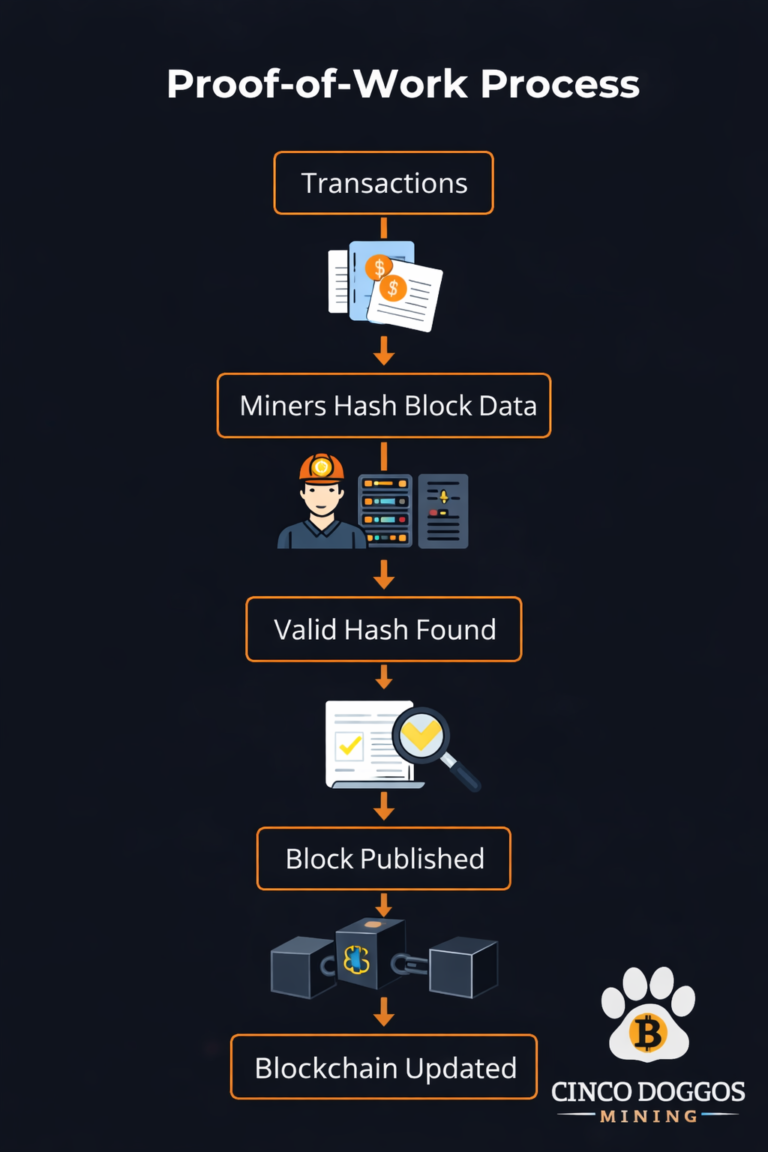
Every block added to the blockchain requires a valid hash. The more total hashrate on the network, the harder it becomes for any single actor to manipulate or attack the system.
In simple terms:
- More hashrate = more security
- More miners = more decentralization
- More competition = a stronger network
This is why Bitcoin’s security model is often described as proof-of-work.
Miners are converting real-world energy into computational work, and that work protects the network.
Hashrate in Real Mining Hardware
Hashrate becomes tangible when you look at actual mining machines.
Each ASIC miner is designed to perform SHA-256 calculations as efficiently as possible.
For example:
- A Bitaxe Gamma might produce a small amount of hashrate for hobby or solo mining
- An Antminer S19 can produce around 90–110 TH/s
- Larger deployments scale this into petahash-level operations
The key point is this:
Hashrate does not exist on its own. It is always tied to hardware, power consumption, and efficiency.
Why Hashrate Alone Is Not Enough
One of the most common misconceptions in mining is:
“More hashrate means more profit.”
That is not necessarily true.
Hashrate must always be considered alongside:
- Efficiency (joules per terahash)
- Electricity cost
- Cooling and infrastructure
A miner producing high hashrate but consuming excessive power may be far less profitable than a more efficient machine.
This is why serious mining operations focus not just on maximizing hashrate, but on optimizing efficiency and cost per unit of work.
Key Takeaway
Hashrate is the foundation of Bitcoin mining.
It represents the raw computational power securing the network and determines how miners compete to produce blocks.
Understanding hashrate is the first step toward understanding how Bitcoin mining actually works, not as speculation, but as infrastructure.
This article is part of the Cinco Doggos Mining Fundamentals series.
New to Bitcoin mining? Start with the fundamentals.
Continue Learning: