
What Is Proof-of-Work?
Category: Fundamentals
Estimated reading time: 5 minutes
The Engine Behind Bitcoin
If Bitcoin mining is the infrastructure of the network, then proof-of-work is the engine that powers it.
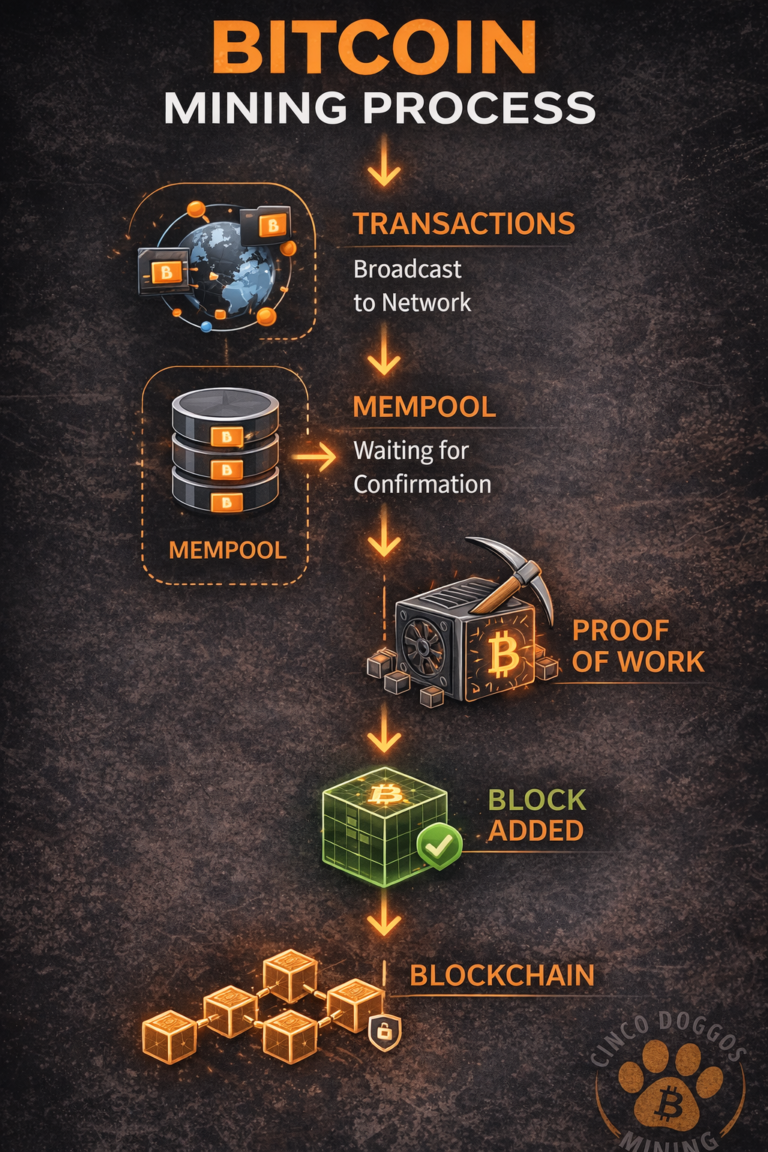
Proof-of-work is the system Bitcoin uses to verify transactions, secure the blockchain, and decide which miner gets to add the next block.
Instead of trusting a central authority, Bitcoin relies on computational work performed by miners around the world.
This work takes the form of billions of cryptographic calculations performed every second.
The result is a decentralized system where security is enforced by mathematics and energy rather than institutions.
The Problem Bitcoin Needed to Solve
Digital money has a unique challenge: preventing double spending.
If a digital currency file could simply be copied and reused, the system would collapse.
Traditional financial systems solve this problem by relying on trusted intermediaries such as banks, payment processors, and clearing houses.
Bitcoin takes a different approach.
Instead of trusting an institution, Bitcoin requires participants to perform verifiable computational work to add new blocks to the ledger.
This mechanism is called proof-of-work.
How Proof-of-Work Functions
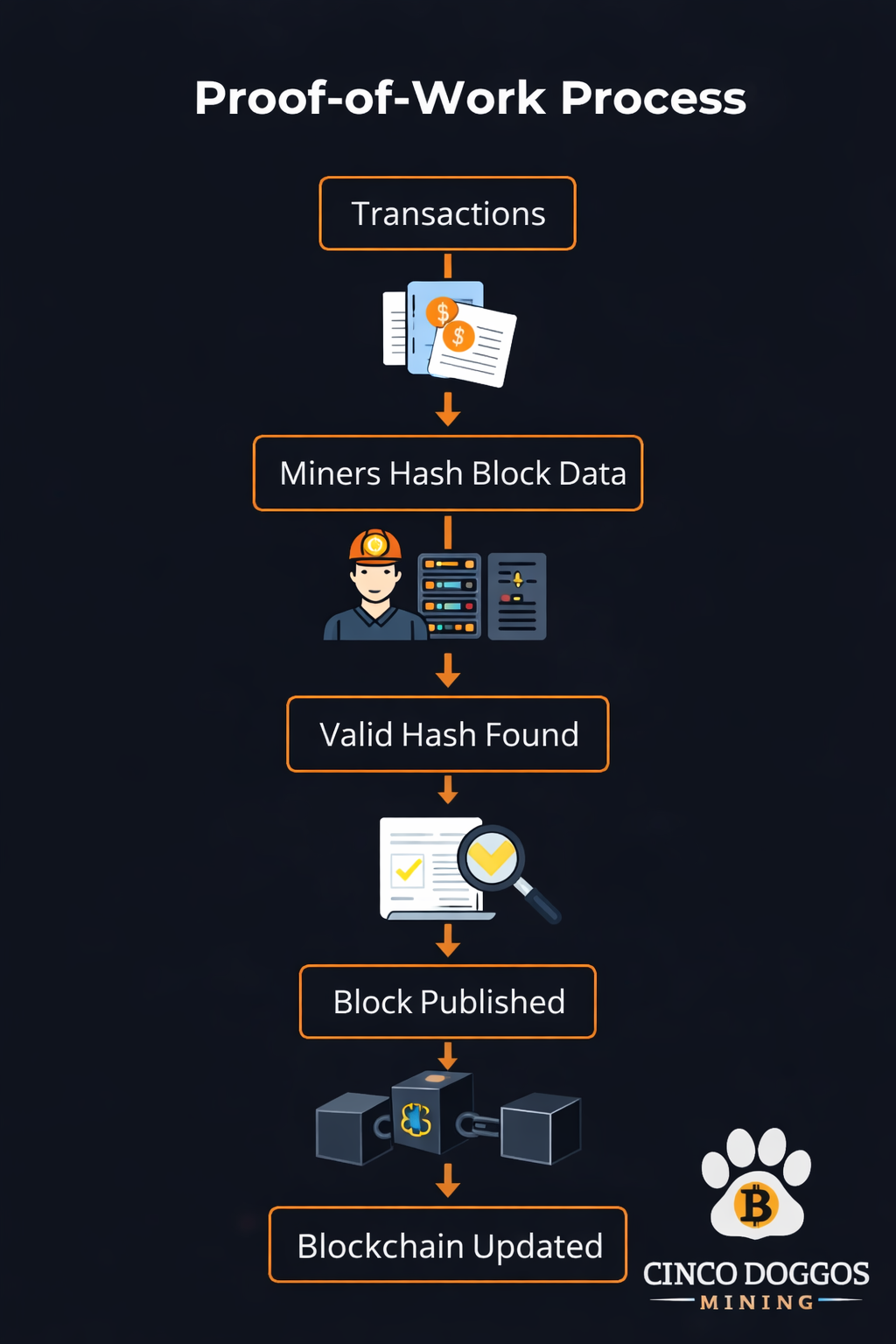
Miners compete to solve a cryptographic puzzle.
This puzzle involves hashing block data repeatedly until a valid hash is discovered.
A hash is simply a long string of numbers and letters generated by Bitcoin’s hashing algorithm.
The challenge lies in finding a hash that is lower than the network’s current difficulty target.
Because hash results are unpredictable, miners must perform enormous numbers of attempts before discovering a valid solution.
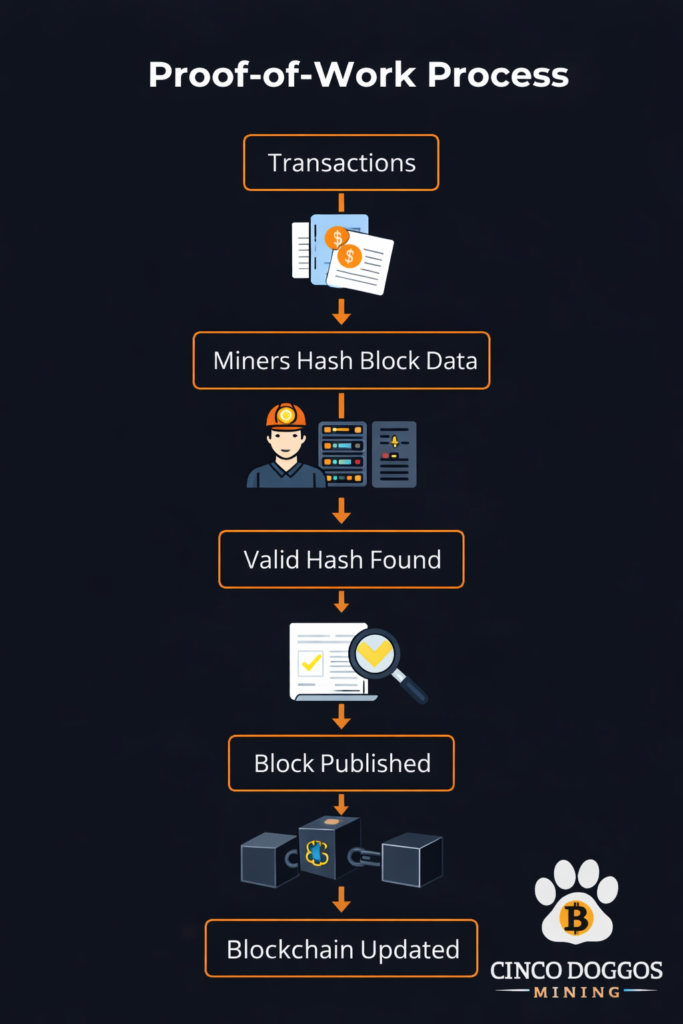
The first miner to find a valid hash wins the right to publish the next block.
This block contains:
- Confirmed transactions
- A reference to the previous block
- A cryptographic proof showing the work performed
Once verified by the network, the block becomes part of the blockchain.
Why Work Matters
The “work” in proof-of-work refers to the computational effort required to find a valid block.
This work requires:
- Specialized hardware
- Electricity
- Time
Because producing a block requires real-world resources, the network gains a form of economic security.
An attacker attempting to rewrite the blockchain would need to reproduce the same amount of work performed by honest miners.
As the network’s total computing power grows, that task becomes increasingly expensive.
This is why proof-of-work converts energy into security.
The Role of Hashing
At the center of proof-of-work is a cryptographic function called SHA-256.
This algorithm takes any input data and converts it into a fixed-length hash.
Even a tiny change in the input produces a completely different hash.
Because of this property, miners cannot predict the correct hash in advance.
The only way to find a valid block is to try millions or billions of possibilities until a solution appears.
This trial-and-error process is what creates the proof-of-work.
How Proof-of-Work Secures the Blockchain
Every block added to the blockchain includes the proof-of-work used to create it.
Each new block also references the block before it.
This forms a chain of blocks secured by accumulated computational work.
To alter a past transaction, an attacker would need to redo the proof-of-work for that block and every block after it.
Meanwhile, honest miners continue adding new blocks to the chain.
This makes rewriting history extraordinarily difficult.
A Personal Perspective by Joe (Cinco)
When people first hear about proof-of-work, it can sound abstract.
But from an operational standpoint, it makes a lot of sense.
In my time serving aboard fast-attack submarines in the U.S. Navy, every system onboard required real energy and effort to operate.
Nothing happened without power being generated and work being performed.
Bitcoin operates on a similar principle.
Instead of trusting an authority to maintain the ledger, the network requires miners to perform measurable work before new blocks can be added.
That work becomes the foundation of Bitcoin’s security.
Proof-of-Work and Difficulty Adjustment
Proof-of-work works closely with another key Bitcoin mechanism: difficulty adjustment.
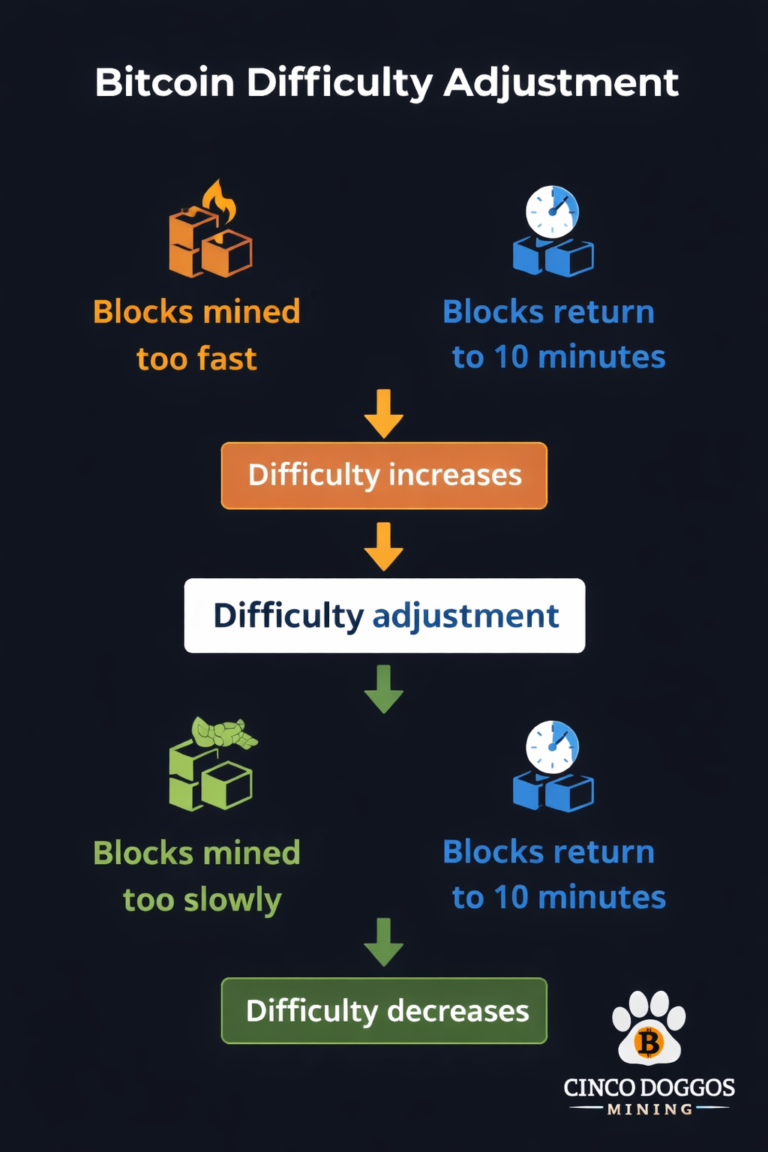
As more miners join the network, the difficulty increases so that finding a valid block remains challenging.
This ensures blocks continue to appear roughly every ten minutes.
Together, proof-of-work and difficulty adjustment maintain Bitcoin’s predictable rhythm.
Why Proof-of-Work Matters
Proof-of-work is what allows Bitcoin to function without centralized control.
It provides:
- Transaction verification
- Block ordering
- Network security
- Resistance to censorship
By tying digital consensus to physical resources like energy and computation, proof-of-work anchors Bitcoin in the real world.
Final Thoughts
Proof-of-work may seem simple on the surface, but it is one of the most important innovations behind Bitcoin.
It replaces trust in institutions with verifiable computational effort.
Miners compete to perform that work, and the result is a decentralized network secured by mathematics, energy, and economic incentives.
Without proof-of-work, Bitcoin would not have the resilience or security that has allowed it to operate continuously since 2009.
This article is part of the Bitcoin Mining Fundamentals series, where we break down how mining works, why it matters, and how the technology behind Bitcoin operates.
Continue Learning: