
How Bitcoin Difficulty Adjustment Works
Category: Fundamentals
Estimated reading time: 5 minutes
Keeping Bitcoin’s Clock Steady
One of the most remarkable design choices in Bitcoin is that the network produces a new block roughly every 10 minutes.
It does this without a central authority controlling the schedule.
Instead, Bitcoin uses an automatic mechanism called the difficulty adjustment.
This system recalibrates how hard it is to mine a block so block production stays consistent, even as miners around the world join or leave the network.
Without difficulty adjustment, Bitcoin’s block timing would quickly spiral out of control.
Why Difficulty Adjustment Exists
Bitcoin mining is competitive.
When more miners join the network, the total computing power—called hashrate—increases.
If the network didn’t adapt, blocks would start being mined much faster than intended.
For example:
- Double the hashrate
- Blocks could appear every 5 minutes instead of 10
That would accelerate Bitcoin’s issuance schedule and disrupt the monetary system Bitcoin was designed to follow.
Difficulty adjustment prevents this.
It ensures that no matter how much computing power enters the network, blocks continue to arrive at roughly the same pace.
How the Difficulty Adjustment Works
Bitcoin adjusts mining difficulty every 2,016 blocks.
Since blocks average about 10 minutes each, that means an adjustment happens roughly every two weeks.
Here’s the basic process:
- The network measures how long the last 2,016 blocks took to mine.
- It compares that time to the expected time of 20,160 minutes, or about two weeks.
- If blocks were mined too quickly, difficulty increases.
- If blocks were mined too slowly, difficulty decreases.
The result is a constantly self-correcting system.
A Simple Example
Imagine a surge of new miners coming online.
Suddenly, the network’s hashrate doubles.
Blocks begin appearing every 6 minutes instead of 10.
When the next difficulty adjustment arrives, the network notices the faster block production and raises the mining difficulty.
After the adjustment, miners must perform more computational work to find a valid block.
Block timing then returns to roughly 10 minutes.
What “Difficulty” Actually Means
In technical terms, mining difficulty controls how hard it is to find a hash below a certain target value.
The lower the target, the harder it becomes to find a valid hash.
Miners must perform more calculations before discovering a valid block.
As difficulty rises:
- More hashing attempts are required
- Mining becomes more computationally demanding
- The network becomes more secure
Difficulty is both a timing mechanism and a security mechanism.
Difficulty Adjustment and Network Security
Difficulty doesn’t just regulate block timing.
It also strengthens Bitcoin’s defenses.
As more miners join the network and difficulty rises, attacking the blockchain becomes dramatically more expensive.
To rewrite Bitcoin’s transaction history, an attacker would need to control an enormous amount of computing power.
The higher the difficulty, the harder that becomes.
This is one reason rising hashrate is often seen as a signal of a healthy and secure network.
A Personal Perspective From Joe (Cinco)
When I first started mining, difficulty adjustment was one of the most fascinating parts of Bitcoin’s design to me.
Coming from a technical background in the U.S. Navy aboard fast-attack submarines, I’m used to systems that constantly monitor themselves and adapt to changing conditions.
Bitcoin does something similar, but without a central control room.
Instead, the network performs the adjustment automatically, helping block production stay steady even as the global mining landscape changes.
It’s one of those quiet mechanisms that keeps Bitcoin operating reliably day after day.
Difficulty Adjustment Process Overview
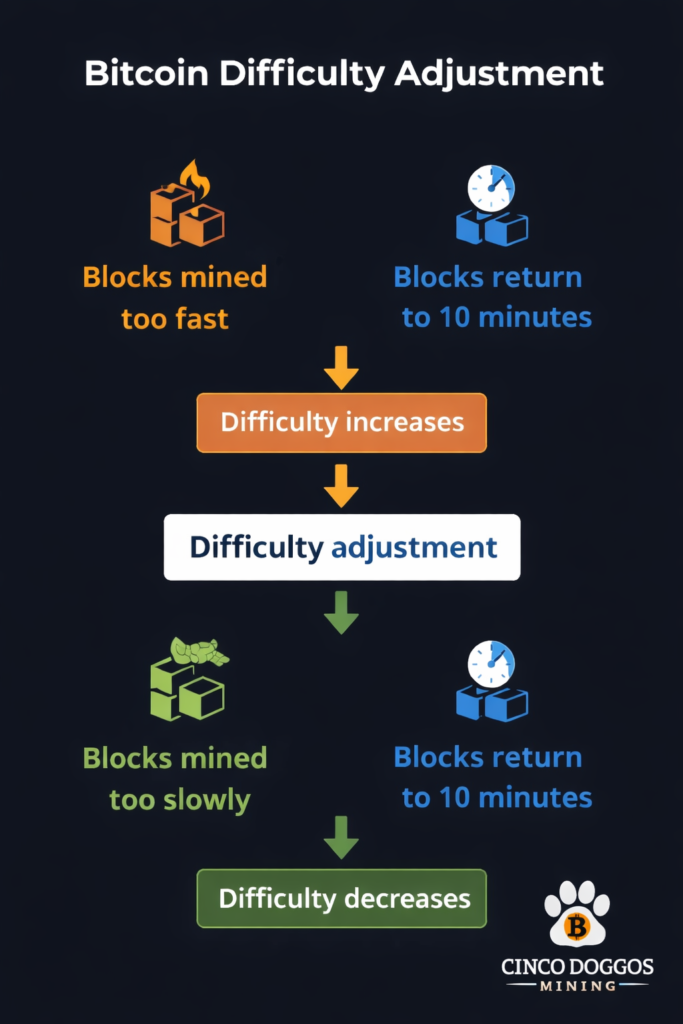
- Miners produce 2,016 blocks
- The network checks how long those blocks took to mine
- If they were too fast, difficulty goes up
- If they were too slow, difficulty goes down
- Bitcoin continues targeting roughly 10-minute blocks
Why Difficulty Adjustment Matters
Difficulty adjustment is what allows Bitcoin to function as a predictable monetary system.
It keeps block production steady, protects the issuance schedule, and helps the blockchain continue growing at a reliable pace.
Without it, Bitcoin would behave unpredictably whenever mining power changed.
Instead, the protocol quietly recalibrates itself every two weeks, maintaining the rhythm that has kept the network running since 2009.
Final Thoughts
Bitcoin’s difficulty adjustment is a simple idea with powerful consequences.
It ensures that no matter how large the mining industry becomes—or how much hardware joins the network—the system continues producing blocks at the same steady pace.
This automatic balancing mechanism is one of the reasons Bitcoin has been able to operate continuously for more than a decade without central oversight.
Just like mining itself, difficulty adjustment shows how Bitcoin turns computation, energy, and incentives into a resilient global system.
This article is part of the Bitcoin Mining Fundamentals series, where we break down how mining works, why it matters, and how the technology behind Bitcoin operates.
Continue Learning: