
Why Bitcoin Mining Is Infrastructure, Not Speculation
Category: Fundamentals
Estimated Read Time: 5 minutes
The Engine Behind Bitcoin
When most people hear about Bitcoin mining, they picture rows of machines chasing digital gold — a speculative race driven by price.
That image is incomplete.
Bitcoin mining isn’t just a way to earn coins. It is the industrial infrastructure that powers the entire Bitcoin network.
Every transaction sent, every block added to the chain, and every dollar of value secured on Bitcoin depends on miners doing a very specific job: turning energy into network security.
Without miners, Bitcoin doesn’t move. Transactions don’t confirm. The network stops.
Understanding mining as infrastructure rather than speculation is one of the most important conceptual shifts for anyone learning how Bitcoin works.
What Bitcoin Mining Actually Does
At its core, Bitcoin mining performs three critical functions:
- Transaction verification
- Block production
- Network security
Miners operate specialized computers called ASICs (Application-Specific Integrated Circuits) designed to perform one task extremely efficiently: calculating cryptographic hashes.
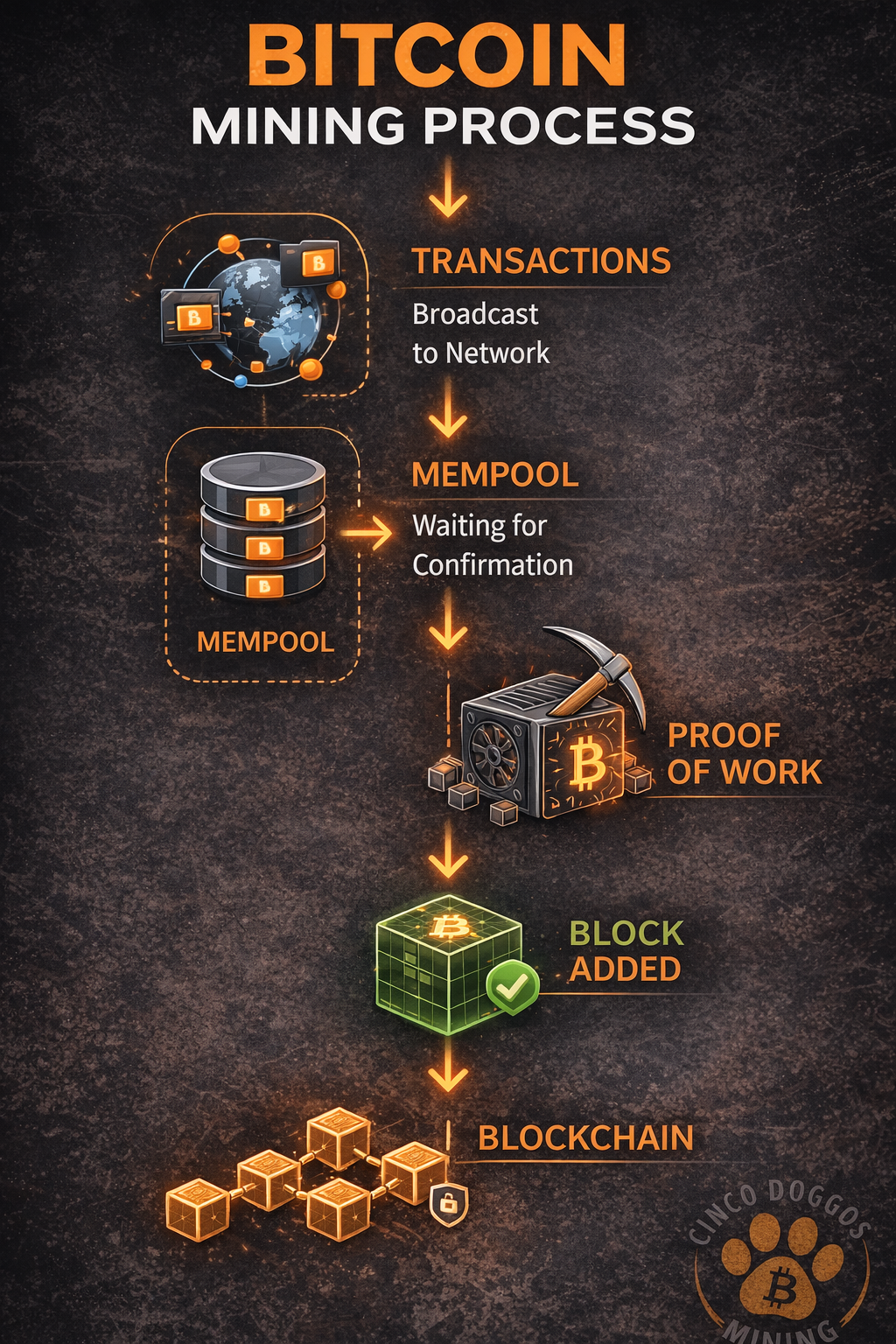
When people send Bitcoin transactions, those transactions are broadcast to the network and temporarily stored in what’s called the mempool — essentially a waiting room for transactions.
Miners gather transactions from the mempool and bundle them into a candidate block.
Then the real work begins.
Miners compete to solve a cryptographic puzzle by repeatedly hashing block data until they find a value that satisfies Bitcoin’s proof-of-work difficulty requirement.
The first miner to solve the puzzle earns the right to:
- Add the block to the blockchain
- Receive the block reward
- Collect the transaction fees inside that block
This process repeats roughly every 10 minutes, producing the next block in the chain.
Block Production: The Heartbeat of the Network
Bitcoin operates like a global clock.
Every block mined acts as a timestamped ledger update, confirming transactions and advancing the chain.
This steady rhythm creates the structure that keeps Bitcoin reliable:
- ~10 minutes per block
- ~144 blocks per day
- ~52,560 blocks per year
Each new block builds on the previous one, creating the blockchain — a chain of cryptographically secured records stretching back to Bitcoin’s creation in 2009.
Changing a past transaction would require rewriting every block after it.
That is where mining becomes critical.
The deeper a transaction sits under additional blocks, the harder it becomes to alter. This is why exchanges and businesses often wait for multiple confirmations before considering a transaction final.
Mining isn’t just producing coins — it’s cementing history.
Energy → Security Conversion
One of the most misunderstood aspects of Bitcoin mining is its relationship with energy.
Critics often focus on energy consumption without understanding what that energy is doing.
Bitcoin mining converts real-world electricity into digital security.
Every watt used by miners contributes to the network’s hashrate, which represents the total computing power protecting the blockchain.
Higher hashrate means:
- More work required to attack the network
- Greater cost to rewrite transaction history
- Stronger resistance to censorship
This energy-backed security is what allows Bitcoin to operate without a central authority.
Unlike traditional financial systems, where trust comes from banks or governments, Bitcoin relies on physics and computation.
You could think of mining as building a massive wall around the network — one powered by energy and mathematics instead of guards and vaults.
A Personal Perspective from Joe (Cinco Doggos)
When I first got into Bitcoin mining, I didn’t see it as speculation. I saw infrastructure. My background is in the U.S. Navy, serving aboard fast-attack submarines, where every system onboard had a purpose — power generation, propulsion, navigation, communication. None of it existed for speculation. It existed to keep the vessel running and the mission moving forward. Bitcoin mining feels very similar to me. Those racks of machines, humming away and consuming electricity, aren’t just chasing rewards — they’re performing the work that keeps the entire network operating. Every hash contributes to the security and reliability of the system, just like every system aboard a submarine contributes to keeping the boat running beneath the surface. Once you start looking at mining through that lens, it stops feeling like speculation and starts looking like what it really is — the engine room of Bitcoin.
Why Mining Matters Beyond Price
When Bitcoin’s price rises, headlines often focus on miner profits or new hardware entering the market.
But mining’s importance goes far beyond profitability.
Mining ensures that Bitcoin remains:
- Decentralized – Thousands of miners around the world compete to produce blocks.
- Trustless – Transactions are verified through cryptographic proof.
- Resilient – The network automatically adjusts if miners leave or join.
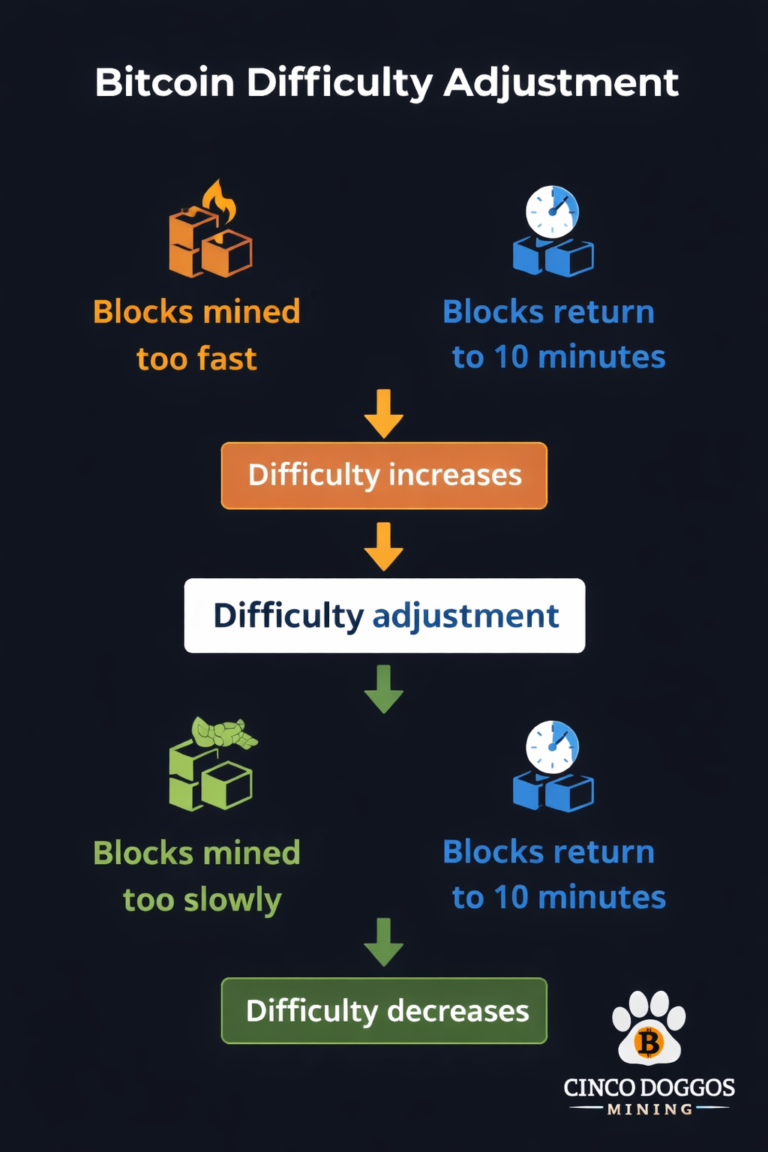
Bitcoin includes an automatic difficulty adjustment every 2,016 blocks (roughly every two weeks).
If mining power increases, difficulty rises. If miners leave the network, difficulty falls.
This mechanism ensures the network continues producing blocks roughly every 10 minutes regardless of changes in global hashrate.
The system is self-balancing — a rare property in financial infrastructure.
Mining as Global Digital Infrastructure
A helpful comparison is to think of Bitcoin mining like other large-scale infrastructure systems.
Just as:
- Power plants generate electricity
- Data centers power the internet
- Shipping networks move global trade
Bitcoin miners provide the infrastructure that allows value to move across the world without intermediaries.
They secure transactions for:
- Individuals sending payments
- Businesses settling invoices
- Exchanges managing liquidity
- Entire economies using Bitcoin as financial rails
Every confirmed Bitcoin transaction relies on the industrial process of mining operating somewhere in the world.
In that sense, miners are not simply traders or speculators.
They are operators of financial infrastructure.
The Long-Term Role of Miners
Bitcoin’s design ensures miners will remain essential far into the future.
The block reward currently provides the majority of miner income, but over time that subsidy declines through halving events, which occur roughly every four years.
Eventually, the network is expected to rely primarily on transaction fees to incentivize mining.
This shift transforms miners into something resembling global transaction processors, maintaining the network by confirming payments rather than issuing new coins.
Even as Bitcoin matures, mining remains the mechanism that:
- Orders transactions
- Secures the ledger
- Keeps the system decentralized
No mining means no Bitcoin.
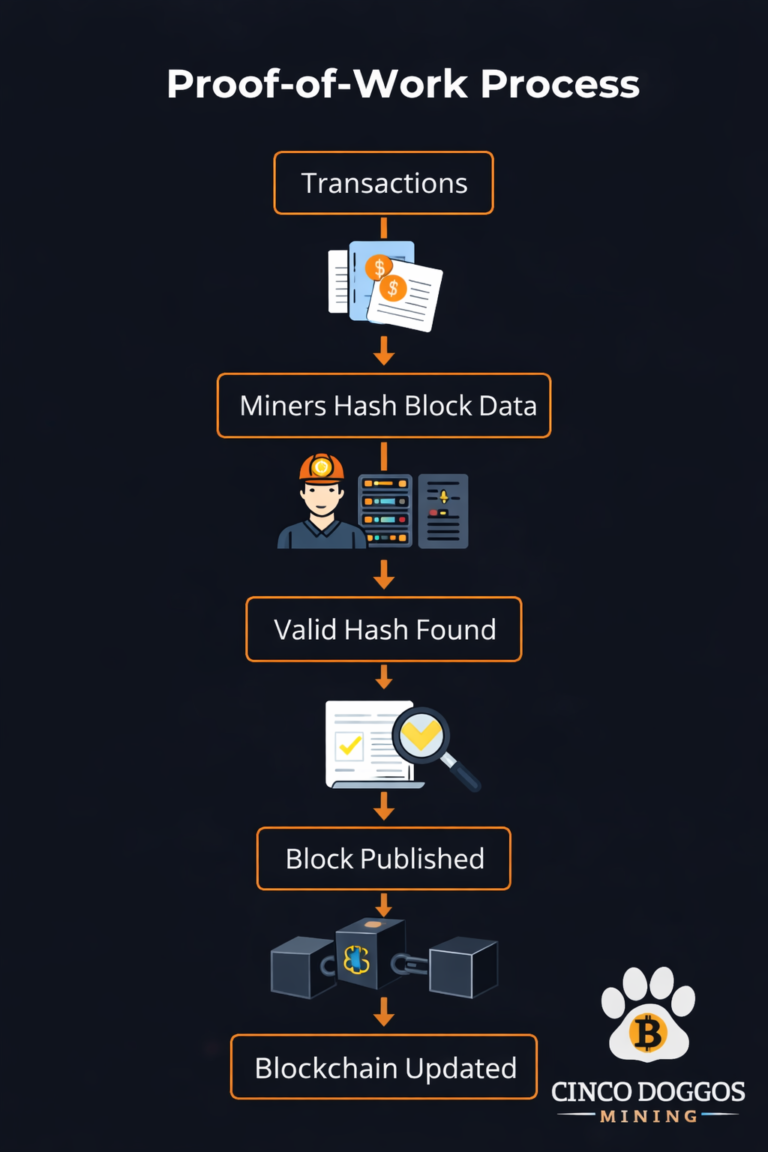
Mining Process Overview
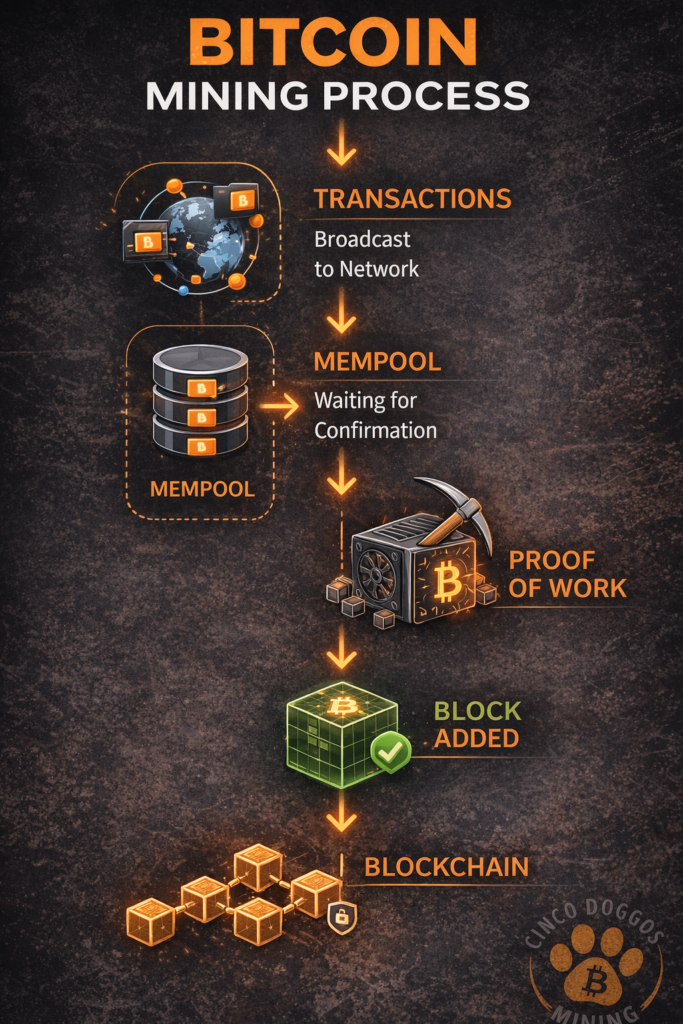
- Transactions are broadcast to the network
- They enter the mempool waiting for confirmation
- Miners bundle transactions into candidate blocks
- ASIC miners compete to solve the proof-of-work puzzle
- The winning miner publishes the block
- The block becomes part of the blockchain
The Bigger Picture
It’s easy to look at Bitcoin mining through the lens of price cycles, hardware releases, or profitability charts.
But those are surface-level effects of something deeper.
Mining is the physical layer of Bitcoin.
It anchors a digital monetary network in the real world by tying it to energy, computation, and economic incentives.
Every block mined reinforces the system’s core promise: a financial network that operates without central control yet remains globally secure.
When viewed this way, Bitcoin mining stops looking like speculation and starts looking like what it truly is:
Infrastructure for a new kind of monetary system.
Final Thoughts
Bitcoin doesn’t run on trust, and it doesn’t run on marketing hype.
It runs on work.
Miners perform that work every minute of every day, turning electricity into cryptographic proof that secures the network for everyone using it.
Understanding mining as infrastructure reveals why it matters far beyond price charts or market cycles.
It’s the engine room of Bitcoin — quietly powering the system block by block.
This article is part of the Bitcoin Mining Fundamentals series, where we break down how mining works, why it matters, and how the technology behind Bitcoin operates.
Continue Learning: